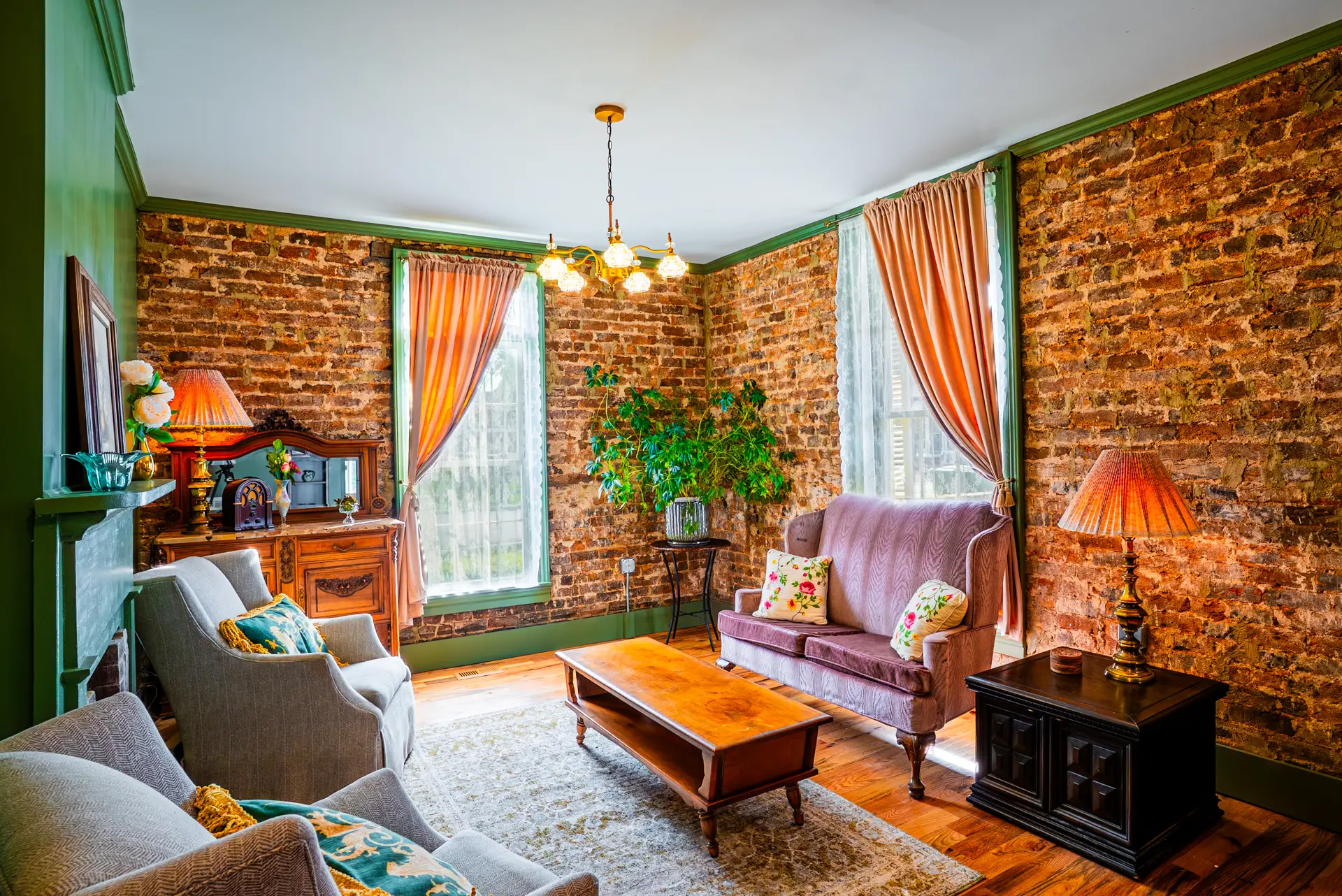
A 150-year-old Italianate home at 404 High Street is preparing to welcome its first guests this week, the culmination of a four-year restoration project that owner Carmyn Dunkin said nearly became more than she and her husband bargained for.

The David Jones House, built in 1874 by prominent local brickmaker and builder David Jones, is listed on the National Register of Historic Places. According to the home’s 1989 National Register nomination, the two-story brick residence is considered one of the best surviving examples of Italianate architecture in Blount County, distinguished by arched windows, brick hood molding and an original interior staircase that has never been significantly altered.
Dunkin said the property came to her and her husband, Ben, through a wholesaler, at a time when the couple were considering scaling back the construction side of their business.
“My husband was like, ‘This is just too much,'” Carmyn reflected.
What changed his mind, she said, was seeing a similarly aged brick home in Knoxville that had already been restored and hit the market.
“That was kind of what really made us more seriously consider it, when we saw that it wasn’t just going to be a money pit — which with historic homes, it could go either way,” Carmyn said admitting the project was still more expensive than they had expected. “It’s taken us four years, so it just about almost was a money pit.”

The couple, who also operate short-term rentals Cabin Coco in Sevierville and Tranquil Treehouse in Townsend, spent about a year securing permits before construction began, a process Dunkin described as far more involved than typical residential work.
“It took a year to get the permits because it is historical and all that good stuff, and the city has strong feelings,” Dunkin said. “It’s just a different ball game than usual.”
Knoxville-based Sieber Restoration and Construction led the build, working alongside a historical review committee and a specialist in historic windows to restore character-defining features, including the home’s front porch and a side bay window, both of which had been removed at some point before the Dunkins purchased the property.
“A lot of the elements to these old houses were put on to help with water and to help with keeping the house cool,” Dunkin said. “We just felt like if we don’t have it the way it was built, we don’t necessarily know what we’re going to deal with.”
The most demanding phase of the project involved rebuilding two exterior walls that had begun pulling away from the structure — brick walls Dunkin said run about 3 feet thick and are structurally critical to the entire house. “If the house had sat another year or something, it probably wouldn’t be there still,” she said.

To match the original material, Ben and his father-in-law traveled to Bulls Gap, Tennessee, after learning through Facebook Marketplace that a school of the same era was being demolished there, and returned with several pallets of nearly identical reclaimed brick.
“We were really happy to find those guys,” Dunkin said. “Historic bricks are a much different size than the bricks we’re using in the last 100 years, and they’re expensive to have remade.”
Deed records reviewed by Maryville City Archivist Mark Bennett trace the property’s ownership beyond what is documented in the National Register filing. Jones purchased the land from Alfred McConnell in 1874 and sold the completed house to W.T. Parham, a former Maryville mayor, in 1880. Parham sold the home in 1902 to Elmer Briton Waller, a Maryville College professor. According to Bennett, Waller’s daughter Emma lived in the house until her death in 1955, and another daughter, Jane Waller Gauding, sold the property in 1967 after leasing it out from Texas.
Jones, a Welsh immigrant who settled in Maryville in 1867 after working as a mason in New York, established a steam sawmill and brickyard and built numerous structures in the city, including the original Blount County Courthouse, completed in 1879 and destroyed by fire in 1906. He later built a second residence in the Second Empire style on the edge of town, now home to Highland Presbyterian Church.
The reopened property will offer both room-by-room and whole-house rental. Dunkin said the model is designed to serve visiting Maryville College faculty and families, as well as wedding parties needing group accommodations that aren’t currently available downtown. Two rooms will include saunas, marking the company’s first venture into wellness-style lodging.
“We’re just trying to serve anyone who could be coming to the area,” Dunkin said.
Nightly rates are expected to range from $130 to $300 depending on the season, though Dunkin cautioned that pricing has not been finalized. She noted that short-term rentals are rare in Maryville’s downtown due to zoning complexity, making direct market comparisons difficult.

Dunkin said she wants guests connected to downtown Maryville’s growing business corridor. She has confirmed a coffee partnership with Vienna Coffee and is in discussions with Walnut Kitchen, Katie’s Kupcakes and The Steel Room, along with Sunshine Chiropractic regarding ways to enrich the guest experience.
She said she is also excited about The Armory, Pinchy’s Lobster & Rawbar and Jersey Hustle Pizza opening nearby to create multiple new walkable destinations for guests to enjoy.
Dunkin said she and her husband are open to acquiring additional Maryville properties in the future, though she noted the David Jones House restoration was likely the most demanding project the couple has taken on and they are looking forward to a break.