When Maryville completed its Downtown Master Plan in 2024, the research painted a picture of the downtown business landscape. The business mix included mostly restaurants, government services and health care. Businesses in the study area numbered around 280, with 7,400 workers and only a few hundred residents.
In other words, Maryville’s downtown was a source of work. Now, property owners, developers and city officials are leveraging capital to revitalize the once office-heavy daytime employment district into a mixed-use urban district — and experts say the city center may be entering a new phase of redevelopment.
Public planning is paving the way
The city of Maryville has spent just under $6.5 million in public investments downtown since 2023 and continues to invest in the area. The work, which addresses multiple projects identified in the city’s Downtown Master Plan, is aimed at streamlining the development process for businesses and increasing downtown’s attractiveness to visitors.
Angie Luckie, public services director for Maryville, said the city wanted to capitalize on increasing downtown interest from the private sector. Branding meetings led to a bid for a downtown study and master plan in 2023. The city spent $142,000 on the plan, and by January 2025 had begun to implement the findings.
Key changes, Luckie said, include consolidating the downtown zoning map. The city collapsed the previous five-zone map into a three-zone version.
“It hopefully makes it more simple for people when they’re trying to figure out what they can and can’t do,” Luckie said.
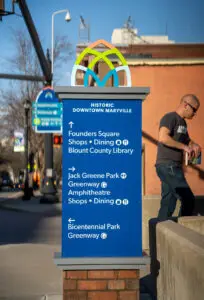
The city has also installed wayfinding signage on block after block to help visitors find key locations and contributed $2.5 million to construction of the Holiday Inn hotel under way on Broadway Avenue. The project will add nearly 100 hotel rooms downtown and include an additional parking garage underneath.
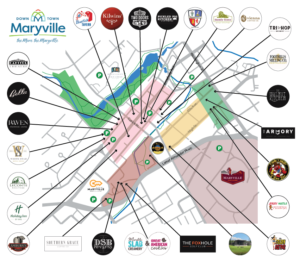
In the future, Luckie said the city plans additional streetscaping and beautification work, particularly around downtown parking near Bluetick Tavern and Bella.
Developers are following
James Tomiczek, a local developer now deeply invested in downtown Maryville, said local leadership gave him the confidence to get started when he saw interest in downtown growing. When he put together a list of downtown projects for a presentation in 2023, he said he could think of 23 projects off the top of his head.
“Now, I look at it and we’re up around 50, with most of them having been done,” he said.
Downtown lease rates are on the rise, too.
“You used to come downtown and find places at about $12 per foot all over the place,” he said. “Now, you’re in the mid $20s.”
New construction, such as Tomiczek’s projects, usually falls in the $30 range. He is nearly finished with Greenway Village — a mixed-use development near West Lamar Alexander Parkway that includes housing, restaurants and entertainment. He is also working on The Mill House at Pistol Creek, a townhome development that will add 20 residential units to the downtown landscape.
On Broadway Avenue, he is planning an “elevated Mexican concept” just across from the site of the future 98-room Holiday Inn.
That project was initially supposed to include additional townhomes, but foundation constraints took a multi-story development off the table.
Other projects are introducing a lean toward hospitality and entertainment, particularly adding nightlife options to the office-heavy downtown.
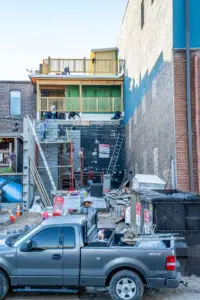
To the east, work is already underway on Scottish pub Wells Tavern, which will bring a rooftop bar to the downtown scene.
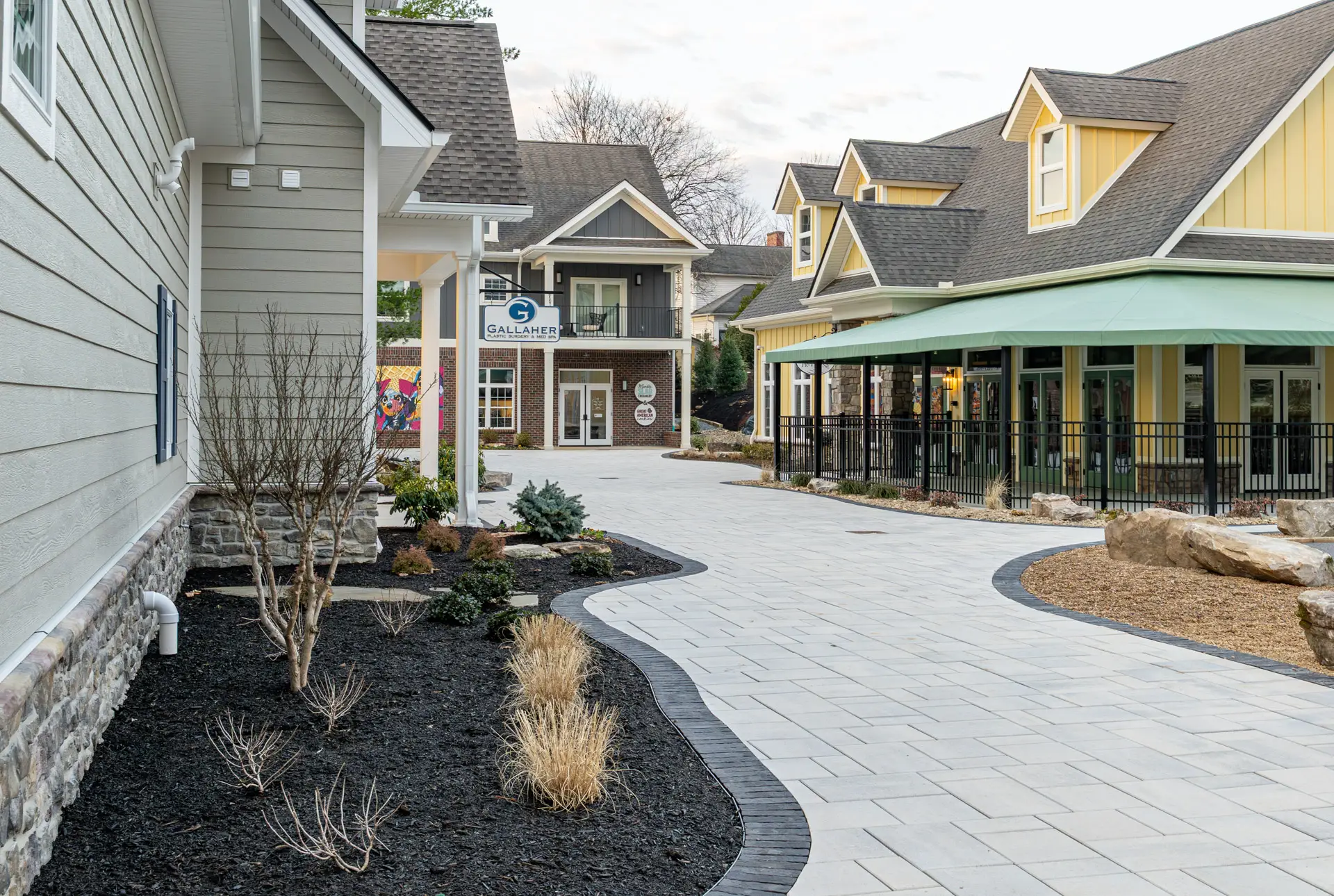
On East Broadway Avenue, across the street from the Downtown Maryville Alliance’s offices, developer PWA Properties is finishing work on what will become a mixed-use development featuring a Kilwins Ice Cream shop, a retail option and housing units upstairs.
In the southeast corner of downtown, Southern Cross Real Estate is developing a connected pair of restaurants — Pinchy’s Lobster and Rawbar and Jersey Hustle Pizzeria. A few hundred feet away, Southern Cross plans to complete the entertainment venue The Armory by the end of summer 2026.
That trio of developments will bring a variety of entertainment and dining options to a corner of downtown previously occupied mostly by offices.
Jeanette Beaverson, who is working on that development, said the decision to group the buildings was purposeful. Maryville College’s proximity was a key factor.
“Those are the entertainment pieces, the ones with outdoor areas, and that’s strategic to tie in the college to downtown,” she said.
Events are drawing traffic
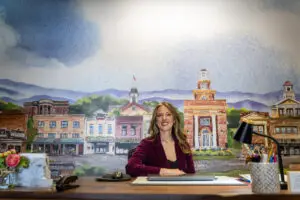
Amanda Gillooly is the executive director of the Downtown Maryville Alliance — a group dedicated to revitalizing the area and fostering downtown business growth. She said the organization has focused its energy on downtown events because those events drive foot traffic and generate potential extra revenue.
Gillooly said retail-oriented programming such as the downtown Holiday Market generates more revenue than passive entertainment options like Summer on Broadway.
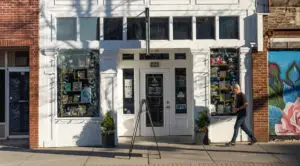
“The Holiday Market is the biggest day of the year for Dandy Lions, J. Danforth and Neighborly Books,” she said, adding that for Summer on Broadway, “It was like your normal farmer’s market. People didn’t shop for the most part. They didn’t eat in the restaurants. They just wanted to use the bathroom, so it really was not an economic boost.”
The goal, she said, is to bring more visitors downtown at a time of day that encourages them to spend money at local businesses. An evening concert, for example, could lead to dinner before and dessert after.
The DMA hosted monthly “3rd Thursday” art walks last summer and plans to recreate them this summer. The organization is also launching a weekly concert series for the next three years thanks to grant money from the Levitt Foundation.
It is hard to estimate the exact number of dollars downtown events generate, she said. But a point-in-time estimate based on cellphone data during one of the art walks puts the visitor count at around 2,000 people.
Program organizers plan to survey downtown businesses at the end of the 2026 season to gauge economic impact.
Gillooly said the concerts won’t feature any household names. She is unsure how many visitors they will bring, noting that it is difficult to predict without precedent.
“Maybe it’s 300 or 400 people. Maybe it’s not even that. I have no idea,” she said. But she and other business owners downtown are hopeful.
Jeff Muir, communications director for the Blount Partnership, an organization helping coordinate the concert series, said the program is not intended to compete with other, larger events like those hosted at the Townsend Event Center.
“These aren’t events that are going to draw tourists to the area,” he said. Instead, he said the series should provide programming for people already visiting or living in the area, increasing regional appeal.
Part of the goal in revitalizing downtown, he said, is to retain the region’s youth — a sentiment echoed by Beaverson.
Maryville is seeing a growing number of high school graduates leaving the area, she said. It is worth it to groups like Massey Electric, which she also works with, to invest in downtown improvement to avoid the region becoming a “retirement town.”
“So we switch gears for a couple of years, remove some of our industrial focus and put some of our eggs in the downtown basket,” she said. “It’s never the most profitable, it’s not ever the easiest, it’s the most difficult work that we do, but it’s the most rewarding and it has the long play with it.”
Residential demand is mixed
To that end, some developers are investing in housing projects. Tomiczek’s townhome development, The Mill House at Pistol Creek, is nearing completion on the eastern side of downtown. He said the project is “doing well; not killing it.”
Homes in the project are currently selling in the $350,000 to $450,000 range.
Gillooly, who said she feels downtown needs more housing, admitted it is hard to sell downtown living to the general public unless they are “drawn to that pedestrian life.” Downtown is missing a grocery store, she said — an element that could be a dealbreaker for some people.
Although residential demand may be mixed, Tomiczek said he is seeing heavy demand to create Airbnb property in the downtown area right now.
He is not certain if that will change when the hotel is finished, but he is fairly confident the local market for downtown stays will still include demand for something more private.
Downtown is constrained
Downtown Maryville technically ranges as far as Peaceful Side Social on the east side of Washington Street, but Gillooly said residents usually think of only the core area as “downtown.” The DMA studies a smaller “Main Street District” that includes 79 parcels, Gillooly said. Within that study sample, 38 of 54 buildings are fully occupied. Two buildings are entirely vacant and nine are partially vacant.
There are 11 ground floors with vacancies and 12 upper floors with vacancies.
Gillooly said the downtown region is naturally bounded by Lamar Alexander Parkway, Pistol Creek and Washington Street. These boundaries limit room for expansion, meaning future development will likely have to occur in existing buildings.
In some cases, that can mean prohibitively expensive repairs before a building can be considered tenant-ready.
Beaverson said many of the buildings downtown have not been well-maintained.
“Until you get that engineering survey and you truly take everything down and get down to the dirt, you don’t know what you’re working with,” she said.
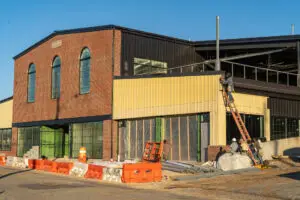
Case in point: The Armory occupies the site of a historic armory, but developers have opted to construct a new building paying homage to the original rather than work with the aged, potentially unsafe structure.
Maryville is turning a corner
Kim Parks, director of the Tennessee Main Street program, said those kinds of signals — rising investment, increasing activity and coordinated local leadership — are typical of downtown districts entering a new phase of development.
Downtown revitalization efforts generally unfold in stages, she said. The first phase focuses on organizing stakeholders and developing a strategy. The next phase, often lasting five to 10 years, is when rehabilitation projects accelerate, fundraising expands and the public begins to understand and support the program’s goals.
“I would characterize the program as just moving into the Growth Phase,” Parks said. “Maryville’s program is a strong Tennessee Main Street program.”
For Maryville’s developers, the long-term goal is to change the balance that once defined downtown — a place where thousands came to work each day but few stayed after hours.
If current projects continue to build momentum, local leaders say Maryville’s downtown may be entering the phase where investment begins reshaping the district’s economics. That means adding residents, extending activity beyond the workday and gradually shifting the area from a daytime employment center into a more balanced urban district.